
Choosing the best strategy for Object Storage encryption

In the cloud era, securing your network perimeter is no longer enough. To guarantee true data confidentiality, protection must be embedded directly into your storage architecture.
As compliance regulations and sovereignty requirements grow stricter, navigating your encryption options can be challenging. This article breaks down the leading API-Amazon S3-compatible encryption alternatives and compares the best strategies for Scaleway Object Storage.
Encryption is non-negotiable.
The threat landscape
You may wonder why your data needs encryption if it’s already stored in a private environment.
The problem is, a “private” environment only addresses one threat vector: network exposure. It does nothing to protect against internal threats, or misconfigured permissions.
Surprisingly, the most significant threat isn’t external, it’s you! Industry statistics consistently show that human error is the leading cause of data exposure in the cloud. This vulnerability is heavily documented by both the ENISA Threat Landscape Report and the IBM Security Cost of a Data Breach Report.
Below is a table unpacking the three risks of data breach:
| Threat | Threat share | Role of encryption at rest |
|---|---|---|
| Human error | High (70%) | Act as a final safety net. if a bucket is accidentally set to “Public”, the data remains encrypted and unreadable to the open internet. |
| Cyberattacks | Medium (25%) | Safeguard against software vulnerability and “zero-day” exploits or isolation by-pass. If an attacker breaches the software layer, they only find useless ciphertext. |
| Drive theft | Low (1%) | Protect against physical compromise. Should a drive be stolen from a datacenter, the raw data can be extracted without the keys. |
What this table makes obvious is that encryption is the last line of defense in an "Assume Breach" security model.
Building a robust lifeguard
Managing critical information , from personal user data to infrastructure keys, requires a rock-solid security strategy. The stakes are high wherever you look:
- Personal data: A breach does more than damage trust; it can lead to massive legal fines and long-term reputational loss.
- Infrastructure access: Control is the foundation of security. A single leaked API key or credential can compromise your entire environment.
Scaleway’s storage services are engineered to meet the world’s most rigorous standards while remaining easy to manage. For example, our HDS (Hébergeur de Données de Santé) certification and (ongoing) SecNumCloud qualification both treat encryption at rest as a non-negotiable requirement.
While HDS ensures the absolute confidentiality of patient records, SecNumCloud demands encryption to guarantee data sovereignty and protection against unauthorized access at every level. Crucially, under SecNumCloud, who holds the keys is just as important as the encryption itself.
The technology behind the shield
Key principles
To build a secure architecture, you need to ensure encryption for each of the three states of data.
- Encryption in transit: Secures data while it travels via protocols like TLS, VPNs, or Private Networks.
- Encryption at rest: Protects data stored on persistent media, such as Block Storage, Databases, or Object Storage.
- Encryption in use: Protects data during active computation (e.g., in RAM or CPU).
The data itself would not be readable in clear at any stages of the journey.
In this article, we will focus on two encryption types: in transit and at rest.
The letter analogy: Journey vs. destination
- The envelope (In transit): When you mail a letter, the envelope acts as a protective wrapper. It shields the contents while they are "in motion" through the network. However, once the letter arrives at its destination and is taken out of the envelope, that layer of protection is gone.
- The vault (At rest): This is where encryption at rest takes over. Think of it as a safe-deposit box inside your house. Even if an intruder breaks into your home (the server) and steals the physical paper, the message is written in a secret code that is impossible to read without the combination, the key.
What does "at rest" actually mean?
In a datacenter environment, data is considered "at rest" the moment it is committed to a persistent physical medium, whether that is a Hard Disk Drive (HDD), a Solid-State Drive (SSD), or an archive tape. Once it stops moving and starts "living" on a disk, it enters the rest state.
Three alternative Amazon-S3 compatible ways exist to set up encryption at rest. Scaleway Object Storage offers them all: SSE-C, SSE-KMS, SSE-ONE. We will detail each of them in the next installment of this series.
Enabling server-side encryption with customer-provided keys (SSE-C)
Enabling server-side encryption with Key-Management-Service (SSE-KMS)
Enabling server-side encryption with object native encryption (SSE-ONE)
What does "in transit" actually mean?
Encryption in transit ensures that your data is encrypted before transmission, scrambled during its journey, and only decrypted upon reaching its destination. This prevents "eavesdropping" or interception by unauthorized third parties.
Scaleway’s Object Storage enforces HTTPS (Hypertext Transfer Protocol Secure), the industry-standard combination of HTTP and the TLS (Transport Layer Security) protocol, to create a secure, encrypted tunnel for all your data exchanges.
While secure tunnels are essential for external data transfers, Block and File Storage work differently. Volumes are mounted directly to your instances via Ceph, so data travels over a dedicated, private, and isolated backend network. In this native storage fabric, the volume behaves as a local physical disk. There is no traditional “public transit” to encrypt as a result.
Deep dive: Algorithms and key management in encryption at rest
Data encryption relies on two fundamentals: the algorithm, which turns data into unreadable ciphertext on the disk, and the key, which allows authorized users to decrypt it.
Both of these fundamentals need to have the right level of security.
- The quality of the algorithm for encrypting and decrypting data, so that an attacker cannot break the algorithm itself with a limited amount of time and resources. Thankfully, the field is already mature and symmetric encryption algorithms are well-known and widely used. At Scaleway, we use AES 256.
- The security around cryptographic keys (= key management), so that an attacker cannot access those keys. The most powerful encryption algorithm in the world is useless if an attacker has access to both encrypted data and encryption keys. This is where most threats will come from.
Quality of the algorithm
We generally distinguish between three main families of algorithms:
- Symmetric encryption (e.g., AES, ChaCha20): This is the most efficient model. A single key is used to both lock and unlock the data. Its lightning-fast processing speed makes it indispensable for handling large volumes of data in real time.
- Asymmetric encryption (e.g., RSA, ECC): This method uses a pair of keys (one public and one private). While mathematically robust, it is significantly slower than symmetric encryption. Therefore, it is primarily used for digital signatures or securely exchanging symmetric keys.
- Hybrid encryption: The best of both worlds. It uses asymmetric encryption to securely exchange a secret key, then switches to symmetric encryption for the remainder of the communication. This is the core mechanism behind the TLS (HTTPS) protocol.
At Scaleway, we chose AES (Advanced Encryption Standard) specifically, AES-256-GCM to guarantee:
- Native hardware acceleration: Direct integration into modern CPUs via AES-NI instructions mean that the encryption of your storage volumes or instances is managed at the hardware level. This ensures near-zero latency for your applications, even under heavy workloads.
- Uncompromising robustness: With a 256-bit key, the number of possible combinations is so vast that a brute-force attack is mathematically impossible with current technology.
The real challenge: managing encryption keys
Managing encryption keys is the ultimate cornerstone of data security, but it comes with a major catch. It's about choosing the right balance of control, convenience, and responsibility.
1. Client-side encryption (CSE)
- The principle: You encrypt your data on your own servers/applications, using your own tools before sending it to Scaleway. You are the only one holding the keys.
- Threats covered: Every threat, including potential Scaleway/cloud provider compromise or misconfigured buckets, as the data is already "protected" when it reaches the cloud.
- Pros & cons:
- Pro: Absolute "Zero-Trust" security and total control.
- Con: High operational complexity; you cannot use server-side features like object versioning or thumbnail generation because the server can't "see" the data. - Best for: Ultra-sensitive workloads. Defense, high-finance, or proprietary research where the provider must never have visibility into the raw data.
2. Server-side encryption with customer-provided keys (SSE-C)
- The principle: You send your raw data to Scaleway, but you include the encryption key in the request header. Scaleway performs the encryption/decryption in memory and immediately discards the key.
- Threats covered: Physical disk theft and software-level isolation bypass within the data center.
- Pros & cons:
- Pro: You maintain exclusive key ownership without having to manage the heavy computational "math" of encryption.
- Con: You must provide the key for every single GET or PUT request. If you lose the key, the data is permanently unrecoverable; Scaleway has no backup. - Best for: High-compliance environments, companies required to store keys "on-premise" while still leveraging cloud scalability.
3. Server-side encryption with Scaleway Key Manager (SSE-KMS)
- The principle: You created a Bucket and paired it with a Key Encryption Key that you previously created in your Key Manager. Each time you upload a new object into your bucket, a Data Encryption Key, encrypted by your Key Encryption Key, will be used to encrypt and decrypt this object. The Key Encryption Key stored in your Key Manager will never be used to encrypt data, only Data Encryption Keys.
Note: at Scaleway, only Symmetric Encryption is available for SSE-KMS - Threats covered: Physical disk theft and software-level isolation bypass.
- Pros & cons:
- Pro: You keep control of the keys without managing the encryption operations yourself.
- Con: You are responsible for the Key encryption Key stored in your Key Manager. If it is deleted, the previously encrypted objects will be lost and no-one - not even Scaleway's employees — will be able to decrypt the data. - Best for: Enterprise-grade security. High-compliance environments: Companies that must use Encryption at Rest but keep the management of their keys.
4. Server-side encryption with Object Native Encryption (SSE-ONE the equivalent of SSE-S3 from Amazon S3)
- The principle: Scaleway handles everything. The system automatically generates and manages unique keys for your objects at the object level. It is "built-in" security.
- Threats covered: Physical theft, software flaws, and unauthorized internal access through centralized auditing and rotation.
- Pros & cons:
- Pro: The simplest "set-and-forget" approach; no performance impact and no configuration required.
- Con: You do not have direct control over the encryption keys; you trust the cloud provider's native security. - Best for: The default standard. Recommended for most users seeking robust security without the operational headache.
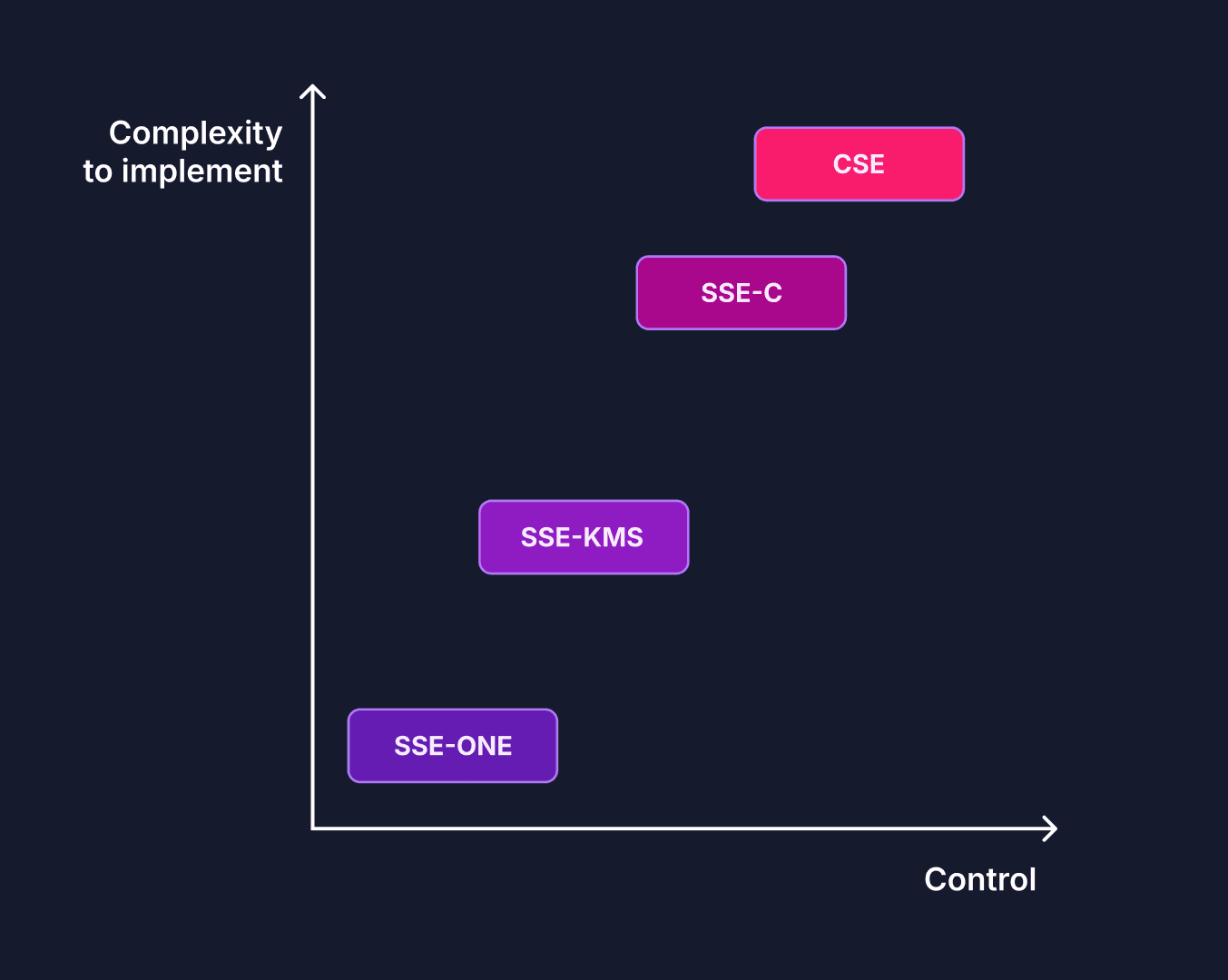
Which of the above options you choose will ultimately depend on your regulatory context, security expectations, and which threats you are the most exposed to.
Whether you prioritize the absolute sovereignty of Client-Side Encryption or the seamless simplicity of native encryption, Scaleway provides the flexibility to align your storage security perfectly with your organization's risk profile and operational capacity.
From encryption strategy to resilience
Choosing the right encryption strategy is a balance between security control and operational simplicity.
We encourage you to evaluate your specific threat model to determine which method best aligns with your goals.
Regardless of the path you choose, your data remains protected by Scaleway’s sovereign infrastructure and our commitment to the highest industry standards.
Roadmap
| Product Line | Available Now | Coming by the end of 2026 | Future (2027+) |
|---|---|---|---|
| Object Storage | • Encryption in transit (HTTPS) • Encryption at rest (SSE-C, SSE-One, SSE-KMS) • Certifications: ISO7001, HDS • Bucket policies • IAM and permissions • Versioning • Object Lock | SNC Scope 1 | Continuous Compliance Updates |
| Block Storage | Encryption at rest (Standard) | SSE-KMS Integration | Continuous Compliance Updates |
| File Storage | - | - | SSE-KMS Integration, Continuous Compliance Updates |